

World Water Day holds special meaning at the Kinark Outdoor Centre (KOC). First, it reminds us that protecting water is essential for a healthy and thriving environment. At the KOC, this reality is visible every day as we look out across the shoreline of Grey Lake, where the centre is situated. Clean water, healthy shorelines, and vibrant ecosystems are deeply interconnected, and the stewardship of these natural spaces is vital for the wellbeing of both wildlife and the communities that depend on them.
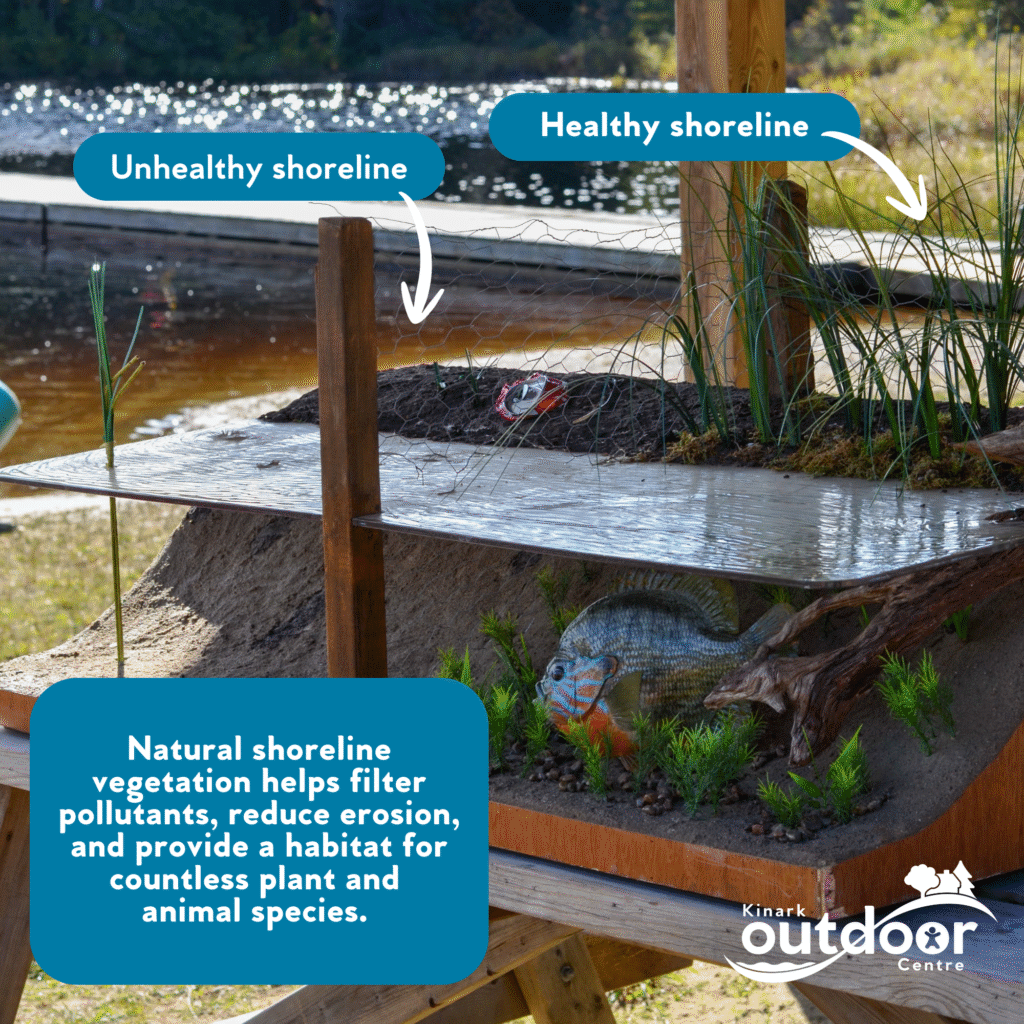
Shorelines play a crucial role in maintaining water quality and ecological balance. Natural shoreline vegetation helps filter pollutants, reduce erosion, and provide a habitat for countless plant and animal species. When shorelines are protected, lakes and waterways are better able to support biodiversity, regulate water temperatures, and maintain the delicate systems that sustain life both above and below the water’s surface. In regions like Haliburton County, where lakes and rivers are central to the landscape, protecting shorelines is not only an environmental priority but also a responsibility shared by the community.
World Water Day also reflects a second value that is central to the Kinark Outdoor Centre: the importance of educating young people. Located on the calm and quiet Grey Lake in Minden, Ontario, the Kinark Outdoor Centre is a full-service outdoor facility nestled in the woods just two hours north of Toronto. Surrounded by forests and water, the centre offers an ideal setting for students to step outside the traditional classroom and experience learning in nature.
Outdoor education has a profound impact on young learners. Research and experience consistently show that students benefit when learning takes place outdoors. Natural environments encourage curiosity, exploration, and hands-on discovery. These elements help bring concepts to life in ways that are difficult to replicate indoors. Students often demonstrate improved retention of information, reduced stress and anxiety, and stronger problem-solving skills when learning in outdoor settings. Outdoor education also fosters independence and confidence, giving students the opportunity to develop autonomy while working collaboratively with their peers.
Each year in October, the Kinark Outdoor Centre partners with F.E.E.L. (Friends of Ecological and Environmental Learning) to host the Haliburton–Muskoka–Kawartha Children’s Water Festival. This event brings together regional students in grades 4 to 6 for an immersive day of learning focused on water conservation and environmental stewardship. By interacting with forty to fifty unique activity centres, students explore topics such as water protection, watersheds, water science and technology. The festival provides hands-on experiences that help students understand the role they play in protecting water resources, while fostering a sense of connection to the natural world.
Experiences like these help cultivate environmental awareness at an early age. When young people learn directly beside lakes, forests, and wetlands, they begin to see themselves as part of these ecosystems. This sense of connection often leads to greater care for the environment and a deeper understanding of how everyday actions can impact natural spaces.
The Kinark Outdoor Centre is proud to provide a highly accessible facility where schools and community groups can explore outdoor education. The centre offers support and expertise with meal planning, activity development, and program coordination, making it easy for educators to bring students into nature for meaningful learning experiences.
On World Water Day, the Kinark Outdoor Centre celebrates both the protection of our waterways and the power of education to inspire the next generation of environmental stewards. By connecting young people with the natural world, we help ensure that our lakes, shorelines, and ecosystems remain protected for years to come.
Sources:
Louv, R. (2019). What is nature-deficit disorder? Children & Nature Network. https://www.childrenandnature.org/resources/what-is-nature-deficit-disorder/
Beaulieu, E., & Beno, S. (2024). Healthy Childhood Development Through Outdoor Risky Play: Navigating the Balance with Injury Prevention (Position statement). Paediatrics & Child Health, 29(4), 255–261. Canadian Paediatric Society. https://cps.ca/en/documents/position/outdoor-risky-play
Shoreline Do’s and Don’ts | Haliburton-Muskoka-Kawartha Children’s Water Festival


